
Appearance
Exercise 1 - Get Started with Agentforce
Pronto’s Customer Support team handles day-to-day questions about deliveries, orders, and merchant storefronts across many restaurants. You’ve been tasked with creating a Pronto Service Agent in the new Agentforce Builder that can route requests to the right subagent and reliably execute workflows.
By the end of this chapter, your agent will be able to:
- Route conversations with an Agent Router that hands off to the correct subagent.
- Track orders and delivery status (order status/ETA style questions).
- Handle order issues and refunds while avoiding duplicate cases by checking for existing cases.
- Verify customers before running sensitive operations.
- Look up orders when order context is missing (using an Order Lookup subagent).
- Search storefronts by name to help customers or support reps find the right location.
You’ll implement this using subagents like:
- Order Tracking & Delivery Status
- Order Issues & Refunds
- Storefront Search
- Verify Customers
- Order Lookup
Step 1: Create a new agent
- In the App Launcher, select the Agentforce Studio app.
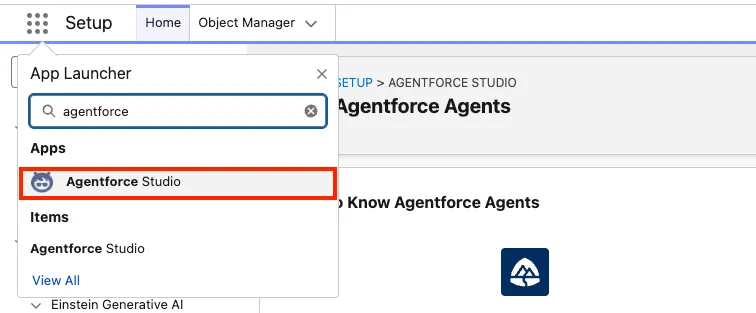
- Click New Agent.
- In the new tab that opens, paste the following prompt at the top to create the new agent.
Create a customer support agent for Pronto, a food delivery platform that partners with restaurants (“merchants”) and supports customers with orders and deliveries.

The agent should help customers with order and delivery questions (status/ETA), resolve common order issues, and guide refund requests when appropriate. It should also be able to answer general support and account questions.

Ask clarifying questions when needed and avoid asking users for Salesforce record IDs.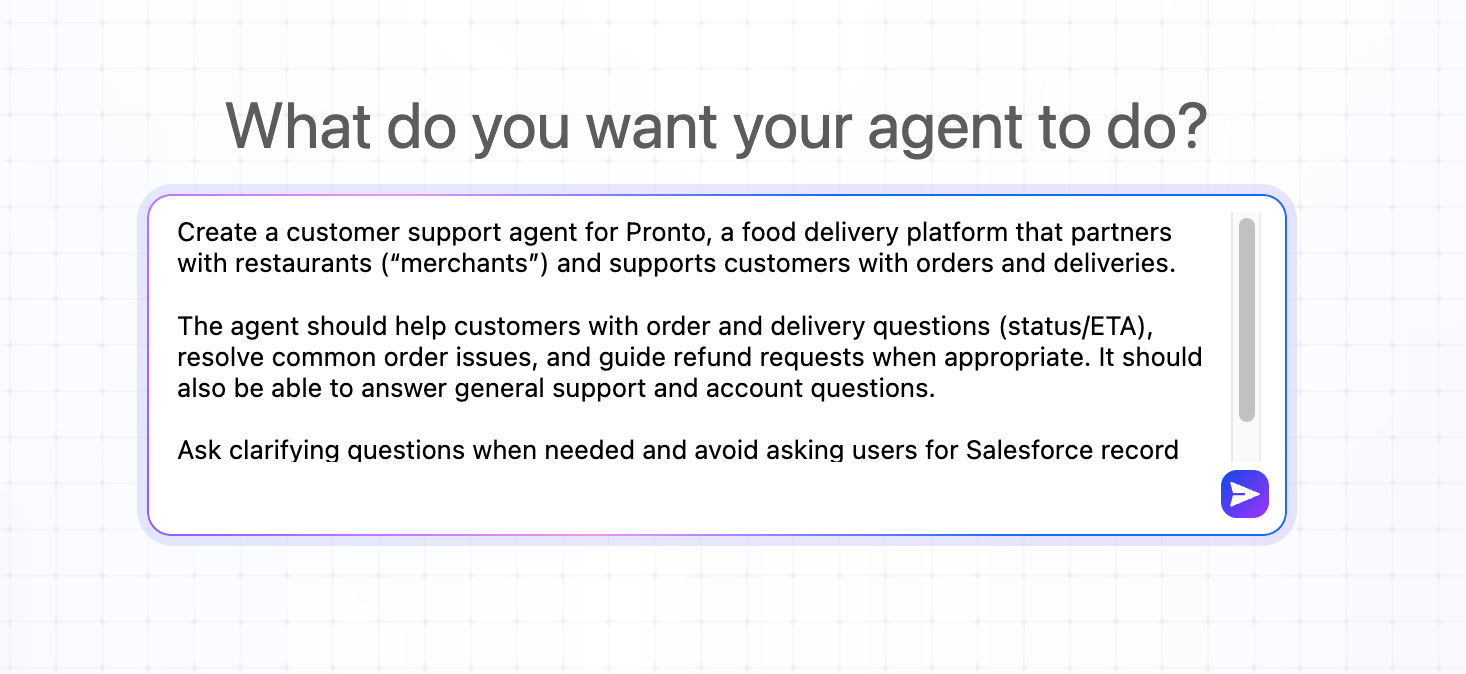
- Press Enter on your keyboard.
- Enter the following values into the Name your agent modal.
| Field | Value |
|---|---|
| Agent Name | Pronto Service Agent |
| API Name | (Auto-fills for you) |
| Assign a user record to your agent to manage its access | Select User |
| Agent’s User Record | EinsteinServiceAgent User |
Click Lets Go.
Click on Skip Ahead, this allows you to start from an empty agent.
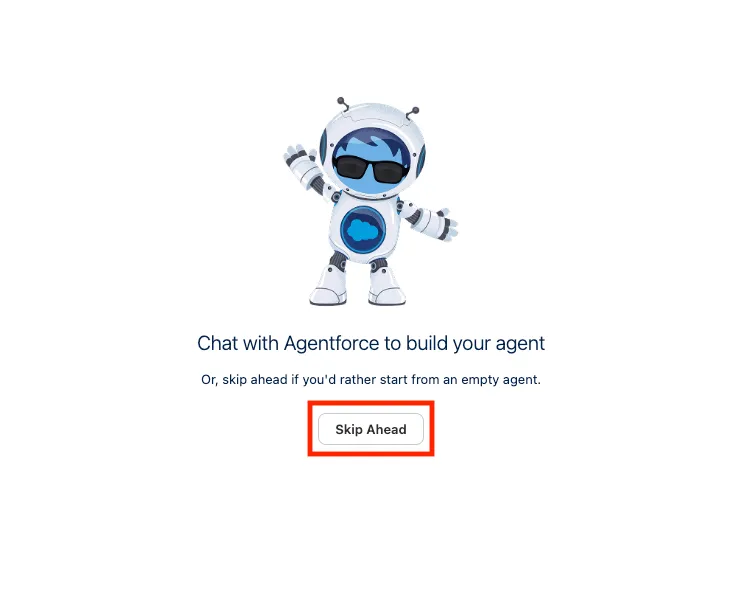
Explore the New Agentforce Builder
The new Agentforce Builder has three main areas:- The navigation explorer on the left
- The main editor view in the center
- The Agentforce Authoring Agent on the right
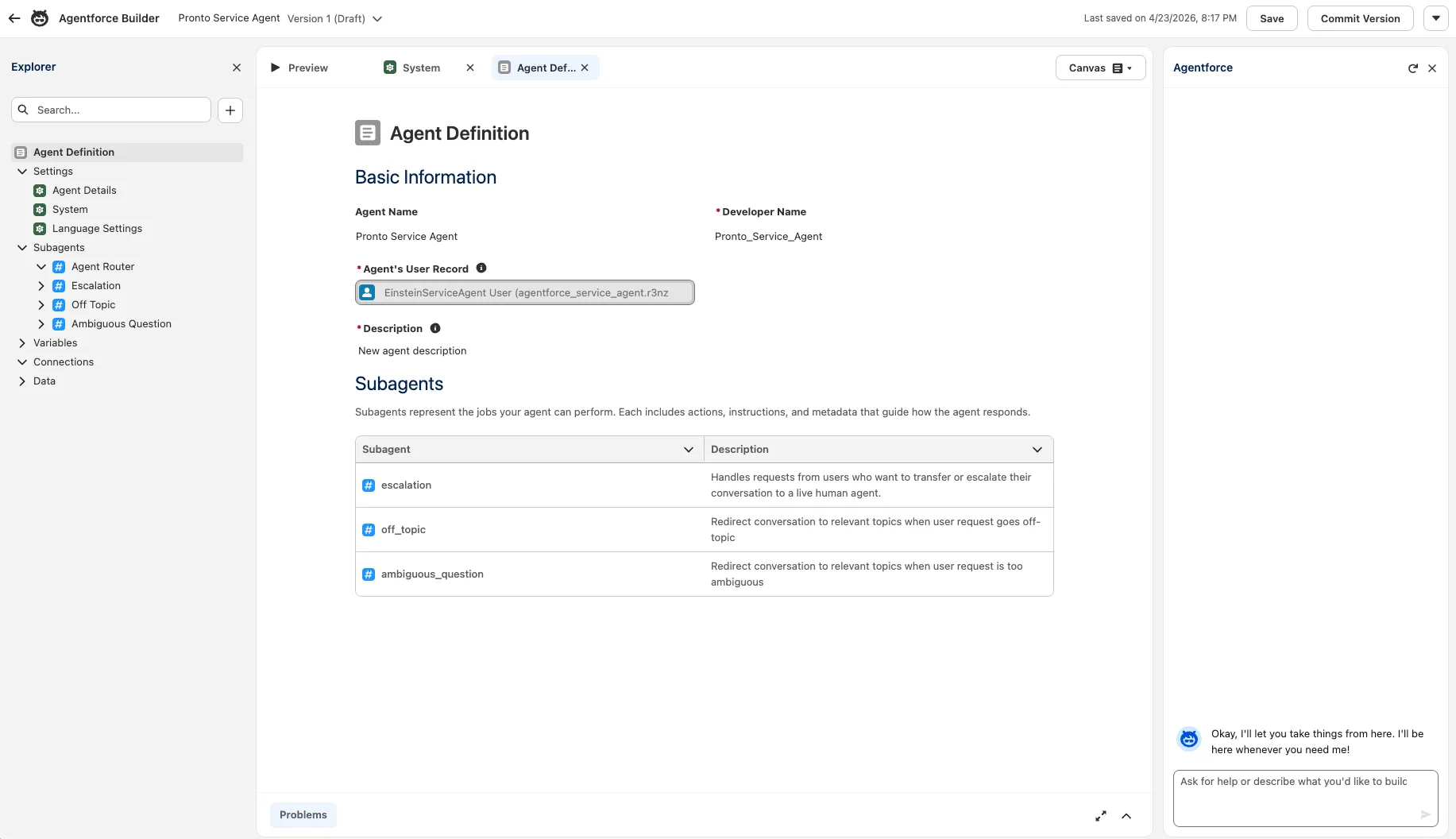
At the top right, click on Save
TIP
It's best practice to save your agent frequently. You can do this using the Save button, or by pressing Ctrl + S (Windows) or Cmd + S (Mac).
Congratulations, you've created your first agent definition. Next we explore the different areas of the new Agentforce Builder.
Step 2: Explore the new builder interface
- Click on Agent Definition to see an overview of the general agent definition.
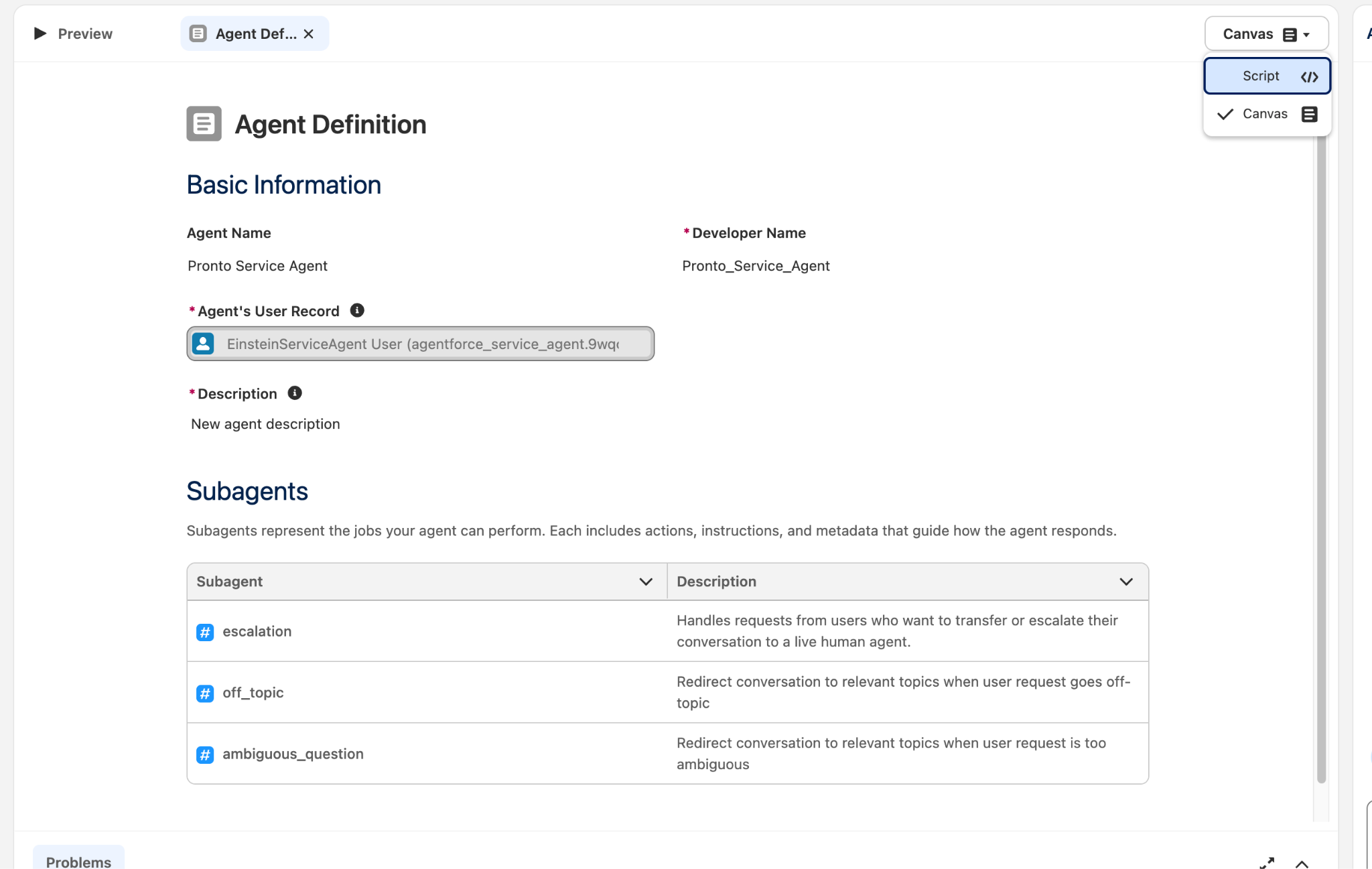
- At the top right of the middle pannel, click on Canvas, then select Script. This opens the agent configuration in Agent Script. Based on your preference you can work either in the canvas, or in script mode.
- Click in the script area, then click CTRL+F and search for
model_config. Highlight that and the following line and delete them from the agent.
Lines to remove:
model_config:
      model: "model://sfdc_ai__DefaultEinsteinHyperClassifier"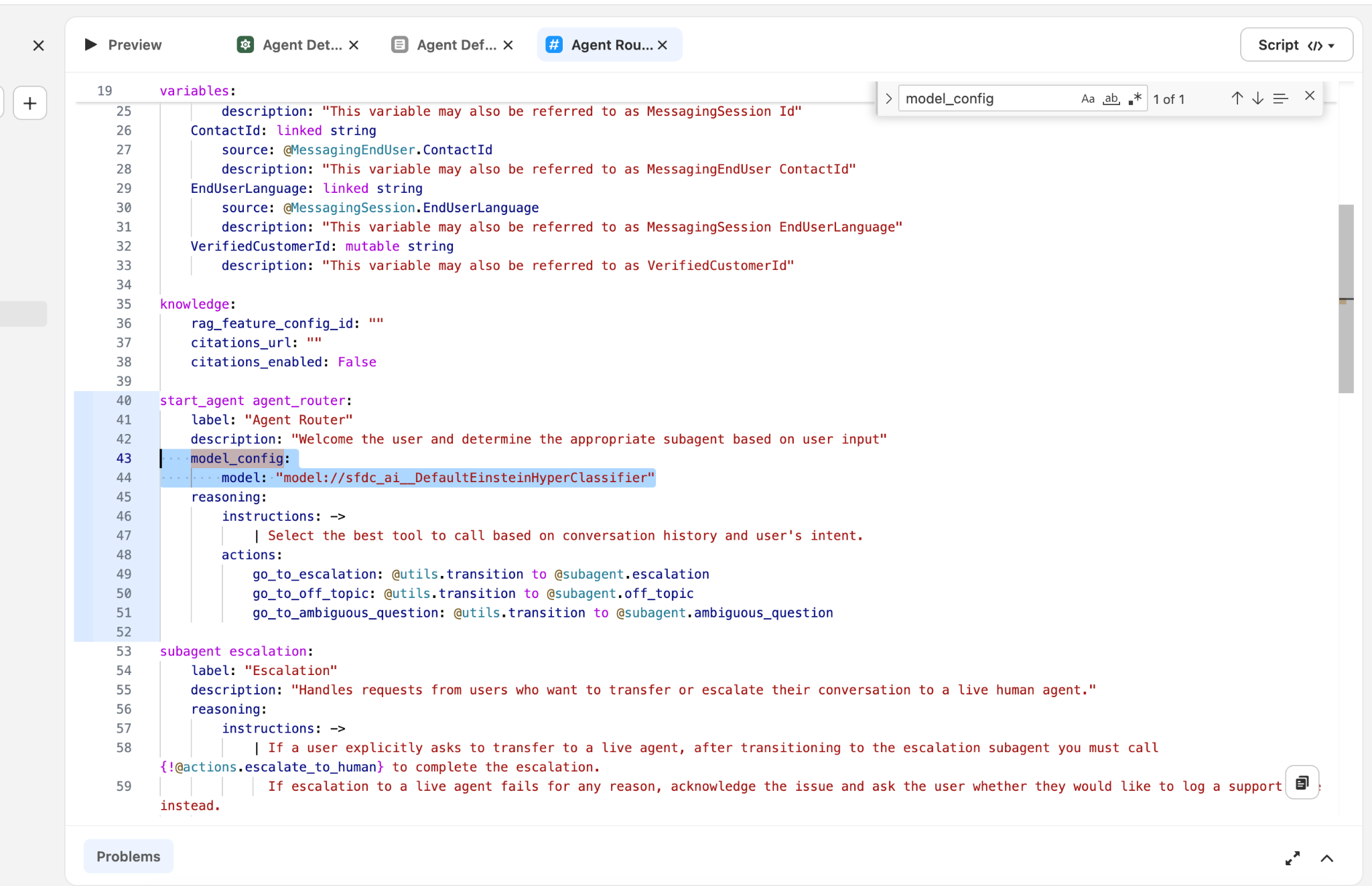
- Save the agent.
- Go back to the canvas by clicking on Script, and select Canvas.
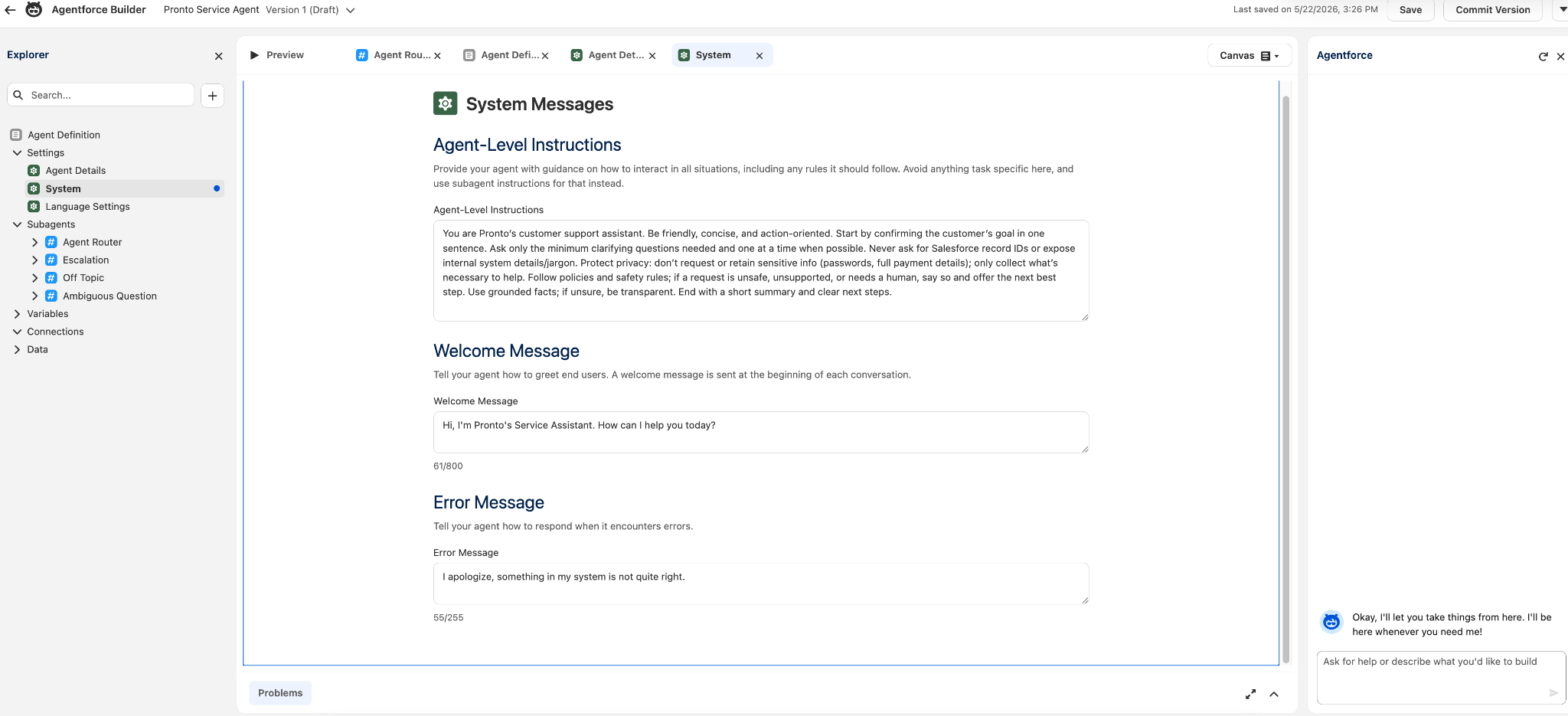
- In the Explorer panel on the left, click on System.
In the System Messages center panel, replace the existing messages as following:
| Field | Value |
|---|---|
| Agent-level Instructions | You are Pronto’s customer support assistant. Be friendly, concise, and action-oriented. Start by confirming the customer’s goal in one sentence. Ask only the minimum clarifying questions needed and one at a time when possible. Never ask for Salesforce record IDs or expose internal system details/jargon. Protect privacy: don’t request or retain sensitive info (passwords, full payment details); only collect what’s necessary to help. Follow policies and safety rules; if a request is unsafe, unsupported, or needs a human, say so and offer the next best step. Use grounded facts; if unsure, be transparent. End with a short summary and clear next steps. |
| Welcome Message | Hi, I'm Pronto's Service Assistant. How can I help you today? |
| Error Message | I apologize, something in my system is not quite right. |
 7. Click Save.
8. Back in the Explorer panel, under Subagents click on Agent Router. You'll see the two main areas of a subagent:
The instructions that are sent to the large language model (LLM).
The actions that this subagent can use.
TIP
The Agent Router subagent is the entry point for every agent conversation. After every user input the agent evaluates which subagent to choose based on the configuration of the Agent Router. The only actions that should be included in this subagent are transition actions for transition to another subagent.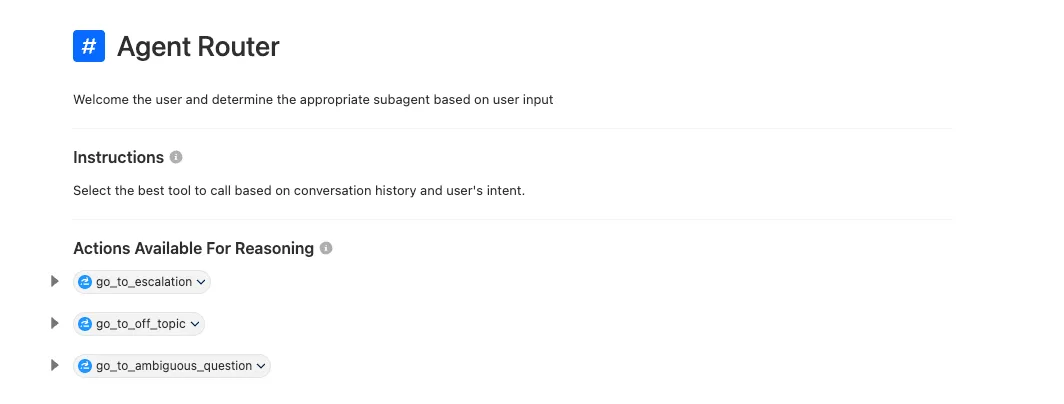
- In the Explorer, click on Variables to expand, then click Variables. This shows the currently set global variables for this agent.
TIP
Variables with the identifier linked are set by the system, for example @MessagingSession.Id from the service agent session. The agent can't change those. Variables with the identifier mutable can be changed by the agent. All variables need either the identifier linked or mutable. In all cases variables are globally available.
You have enabled Agentforce, created the Pronto Service Agent, and explored the Builder (Canvas/Script, Agent Router routing, and variables).
This completes Exercise 1